Financial markets are a place where investors buy and sell different assets. With rapid digitization, good internet connectivity and easy to use platforms are helping in the growth of online trading apps rapidly. Investors are easily investing through their smartphones. These days investors often compare commodity trading and stock trading to find out the best suitable option for their future goals. These two markets offer different benefits and have different types of risks associated with them. In this blog we will compare the difference between both these investment options and learn how they function.
What Is Commodity Trading?
To begin with commodity trading an investor should firstly have a reliable commodity trading app. Investing through these platforms gives easy market access where you can invest directly.
The commodity market majorly deals in physical raw materials that are required by the industries across the globe. These raw materials are an essential part of our daily life and the global industries.
These commodities are divided into different categories which includes precious metals like gold and silver. Here energy products are also included like crude oil, base metals like copper, and agricultural crops like wheat and cotton.
In this investors buy and sell contracts that are post dated based on expected future prices of these raw materials. Investors deposit a small margin amount that controls the whole contract value. A trader deposits a small margin amount to control a larger contract value. Physical delivery of the goods is rare, as most contracts are settled in cash before they expire.
Major commodity exchanges are Multi Commodity Exchange (MCX) that focuses on heavy metals & energy and National Commodity and Derivatives Exchange (NCDEX) that focuses on agricultural commodities. Both the exchanges are strictly regulated by SEBI (Securities and Exchange Board of India) so that investors and trades are safe.
What Is Stock Trading?
In stock trading investors buy and sell the shares of publicly listed companies. When investors buy it means owning a small portion of the company. If the company performs well, grows and makes profit the value of your share will also increase.
Investors can invest in different types of companies as companies are differentiated in large cap, mid cap, and small cap companies. Also companies are grouped in sectors like banking, technology, automobile, healthcare etc.
Orders can be placed by the investors through registered brokers. The price of these stocks go up and down depending upon the company’s performance, earnings, future growth plan, and overall product demand. If the company performs well investors sell off their shares and make money by selling the shares at a higher price than they bought them.
There are two main exchanges for stock trading in India, the Bombay Stock Exchange (BSE) and the National Stock Exchange (NSE). Both these exchanges are strictly monitored by the Securities and Exchange Board of India (SEBI).
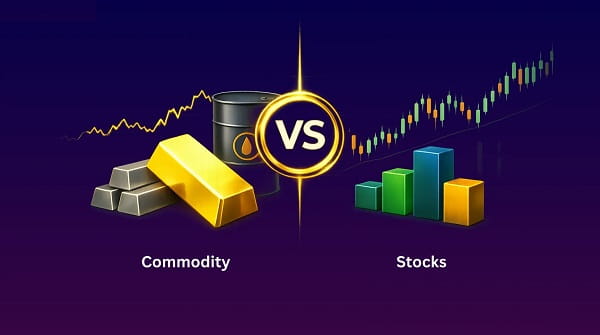
Commodity Trading vs Stock Trading
| Feature | Commodity Trading | Stock Trading |
| 1. Underlying Asset | Physical raw materials like gold, crude oil, or wheat. | Shares representing partial ownership in corporate companies. |
| 2. Market Drivers | Global supply shortages, weather conditions, and geopolitical events. | Company earnings, management changes, and corporate news. |
| 3. Trading Hours | Extended hours, often from 9:00 AM to 11:30 PM, matching global markets. | Standard hours between 9:15 AM and 3:30 PM. |
| 4. Volatility | Experiences rapid price changes due to fast moving global news. | Can be volatile but is often more stable over long holding periods. |
| 5. Liquidity | High liquidity for major global materials like gold and oil. | High liquidity for top performing companies. |
| 6. Leverage and Margin Requirements | Requires a small margin deposit to trade large volumes. | Requires full payment for delivery, with margin available for intraday trades. |
| 7. Risk Exposure | Broad global economic risks and currency fluctuation risks. | Risks related directly to specific companies and industries. |
| 8. Regulatory Framework | Strictly regulated by SEBI to ensure fair trading practices. | Strictly regulated by SEBI to protect shareholder interests. |
Commodity Trading vs Stock Trading
Short-Term Profit Opportunities: The commodity market is highly active with extended hours. Traders use this daily volatility to find multiple short-term profit opportunities within a single day.
Long-Term Return Potential: Stocks are best suited for long term holdings as strong companies grow steadily over years giving a good profit potential to the investors.
Historical Performance Comparison: Generally stock market shows a consistent growth over a long period of time whereas commodities market have cycles of high or low price fluctuation instead of constant upward growth.
Impact of Market Cycles: During periods of strong economic growth, corporate stocks perform very well. When researching the Best Commodities to Trade, investors often look at market cycles to find highly liquid options like gold for uncertain economic times.
Advantages of Commodity Trading
Portfolio Diversification: Commodities show different movements compared to traditional stocks. Commodities can lower your overall risk during a falling stock market commodities generally hold their value.
Hedge Against Inflation: During inflation prices of the raw material rises, making it a good way for investors to protect their money from losing its purchasing power.
Opportunities During Economic Uncertainty: Global uncertainties directly affect the stock market as it creates panic selling. However, commodities like gold generally gain their value during such situations.
Potential for Short-Term Profits: Highly fluctuating and volatile market makes it difficult for the traders to book profits. Due to which traders use price swings in crude oil or silver to generate short term profits.
Lower Correlation with Equity Markets: Commodity market is not dependent upon the corporate stock market trends which helps in balancing from sudden market shocks.
Advantages of Stock Trading
Long-Term Wealth Creation: Stocks are the best way to build wealth over a period of time. Companies compound their earnings, which increases the share prices over time.
Ownership in Businesses: The investor gets real ownership of the company and some companies even give voting rights to their shareholders.
Dividend Income Opportunities: Investors get some portion of the annual earnings directly. These regular payouts are called dividends which provide a steady passive income to the investors.
Capital Appreciation Potential: A well managed company will see its business expand and its share price increase over time. This creates substantial capital appreciation for the patient investor.
Easier Fundamental Analysis: Investors can study a company balance sheet, sales reports, and management quality. This business information is widely available and simple to analyze compared to complex global weather patterns.
Risks of Commodity Trading
- High Volatility: Prices of raw materials can jump or drop very fast in a single trading session which can lead to quick losses.
- Global Economic and Geopolitical Risks: Global trade wars, conflicts, or policy changes directly affect the commodity prices heavily. A major global event can disrupt the raw material supply chain entirely.
- Leverage-Related Losses: Since traders only pay a small margin upfront, a slight price drop can wipe out the entire deposited amount. This makes leverage highly risky.
- Seasonal Price Fluctuations: Agricultural commodities depend entirely on monsoons and harvest seasons. Unexpected bad weather can cause sudden and severe price changes.
Risks of Stock Trading
- Company-Specific Risks: If the company fundamentals are weak, faces legal issues, or fails in making profits your profits can directly reduce.
- Market Corrections and Crashes: General economic slowdowns can cause the entire stock market to fall. This can reduce the portfolio value among every sector.
- Sector Concentration Risks: Putting all your money in one industry like technology or banking can be a risky step. If the specific sector faces challenges your investments directly suffer.
- Emotional Trading Decisions: Daily stock price changes can make investors panic, leading to emotional buying or selling that can give huge financial losses.
Which Is Better for Different Types of Investors?
- For Beginners: The stock market is usually simpler to understand. Beginners can easily start by buying small amounts of shares in strong, familiar companies.
- For Long-Term Investors: Stocks are ideal for those looking to build solid retirement wealth over a span of several decades.
- For Active Traders: The commodity market provides extended hours and high daily movement. This environment perfectly suits active traders who monitor screens constantly.
- For Risk-Tolerant Investors: Commodities involve high leverage and unpredictable global risks. This is highly suitable for individuals comfortable with taking bigger risks for potentially bigger rewards.
- For Conservative Investors: Large and stable stocks that pay regular dividends are a much safer choice. They offer steady growth without causing excessive daily panic.
Conclusion
Both stock trading and commodity trading serve important purposes in the financial world. Stocks help individuals build wealth alongside growing companies over time. Commodities provide essential protection against inflation and global uncertainties. There is no single correct choice for everyone, as different financial goals require different tools.